A simulator can't replace the water, but it lets you practice underwater search as many times as you need, on the same area or a new one every time.
Sonar settings
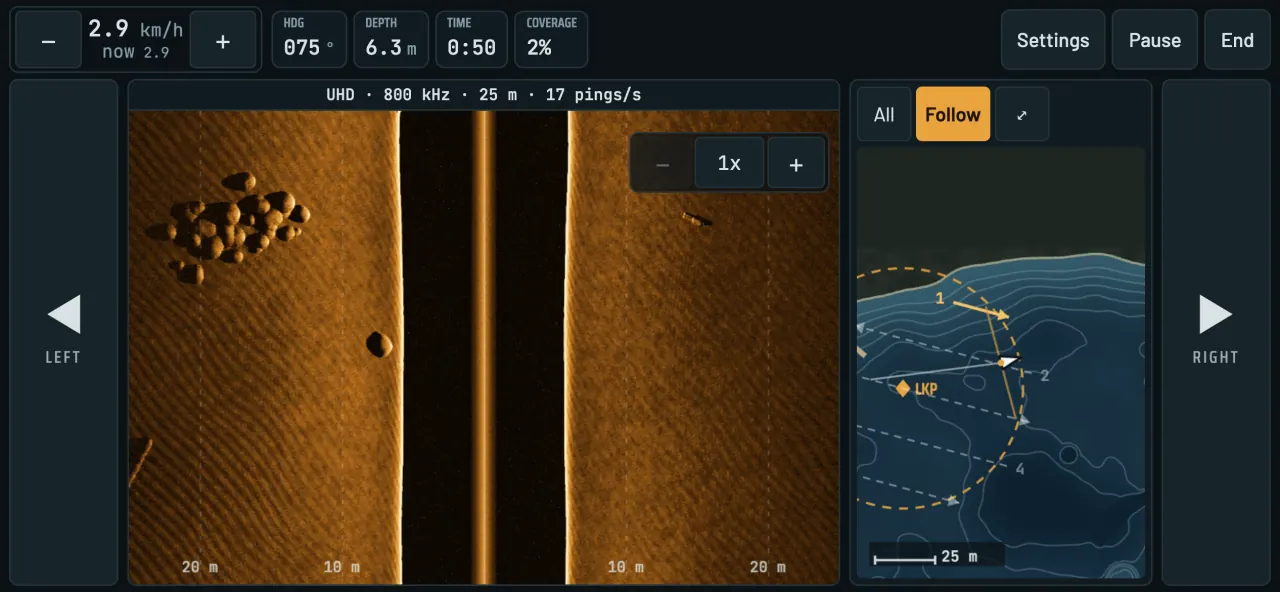
The simulator currently models side-scan sonar. Range, frequency, gain and contrast change the image the way they do on a real unit: a higher frequency gives a sharper image and less range, and in deep water part of the range is taken up by the water column. You see transducer ringing, the nadir gap under the boat and shadows behind objects.
Standard 455/800 kHz · UHD 455/800/1000 kHz · 10-60 m range · 6 palettes
Boat handling and search patterns
You steer the boat yourself: heading, speed, wind, waves and river current. A parallel-line pattern with recommended line spacing helps you cover the whole LKP circle, and the simulator tracks cross-track error, completed lines and area coverage.
pattern lines · spacing with swath overlap · LKP area coverage
Telling a target from trash
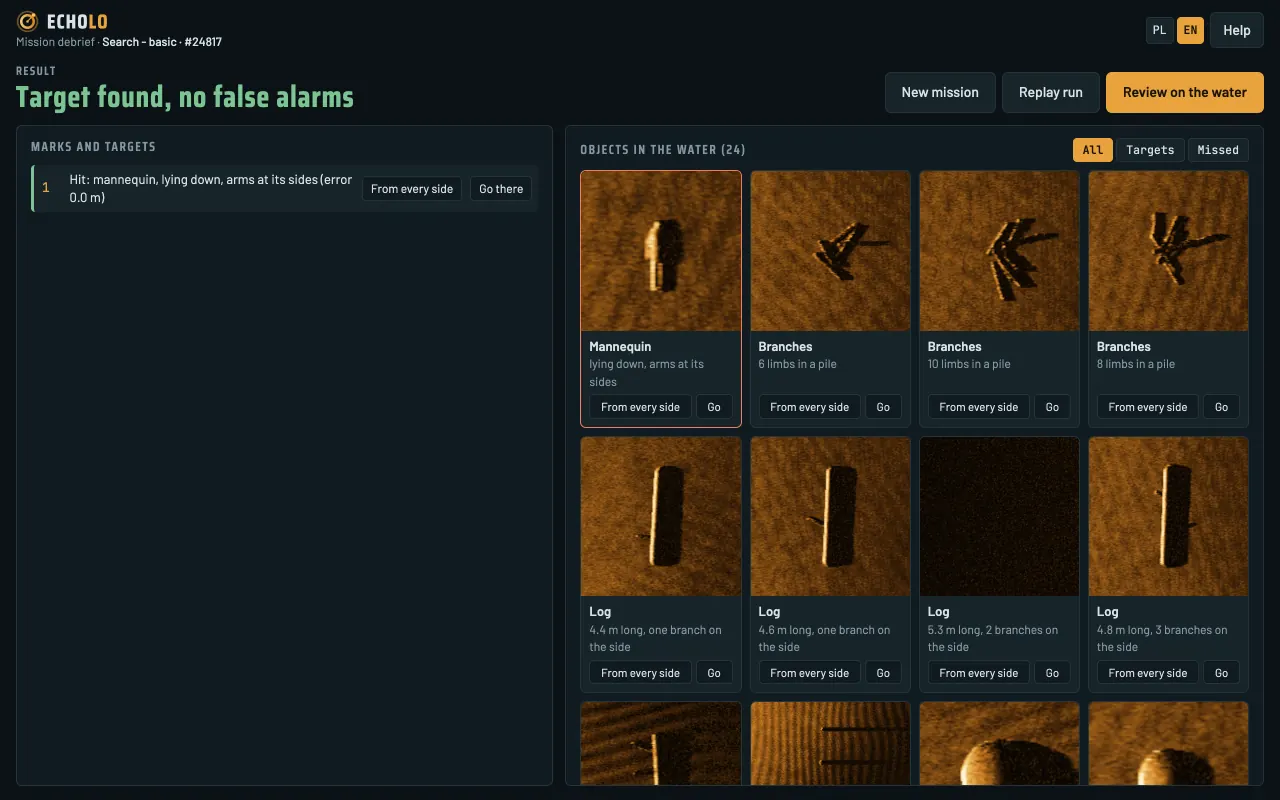
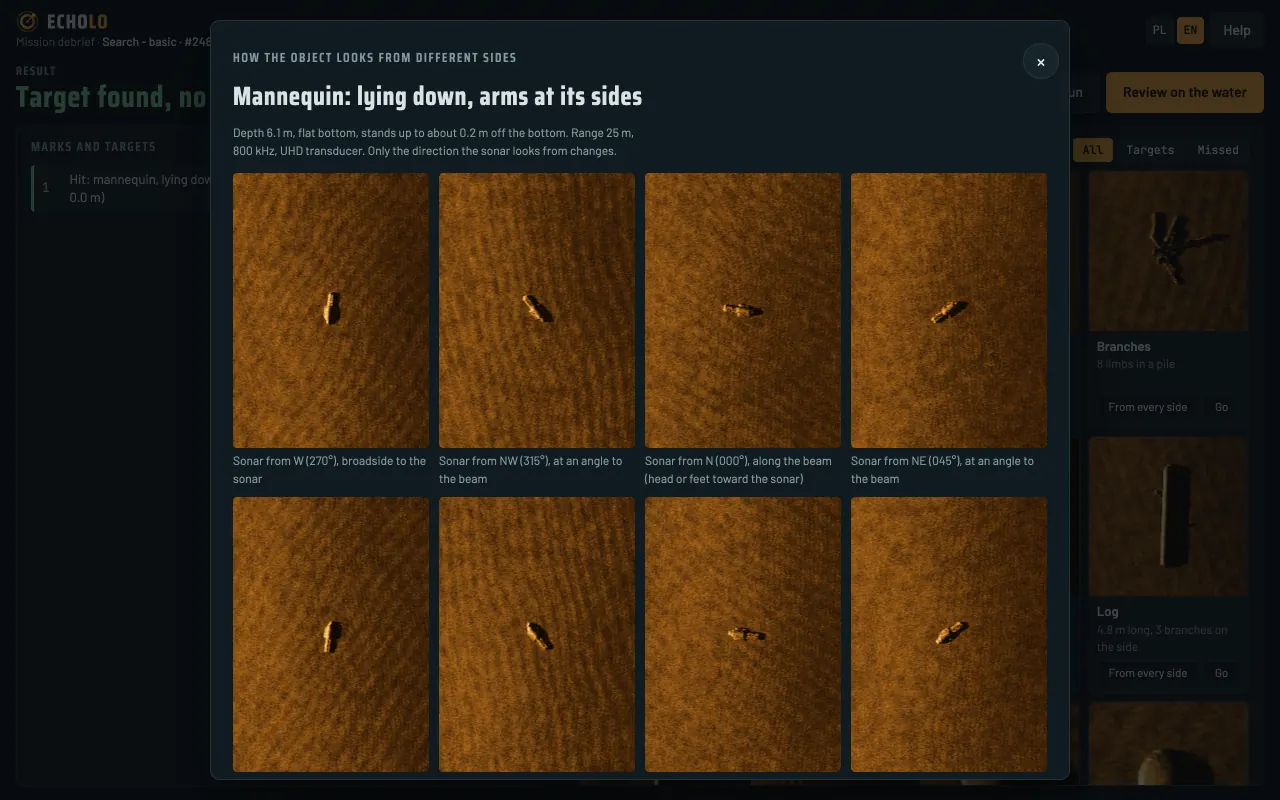
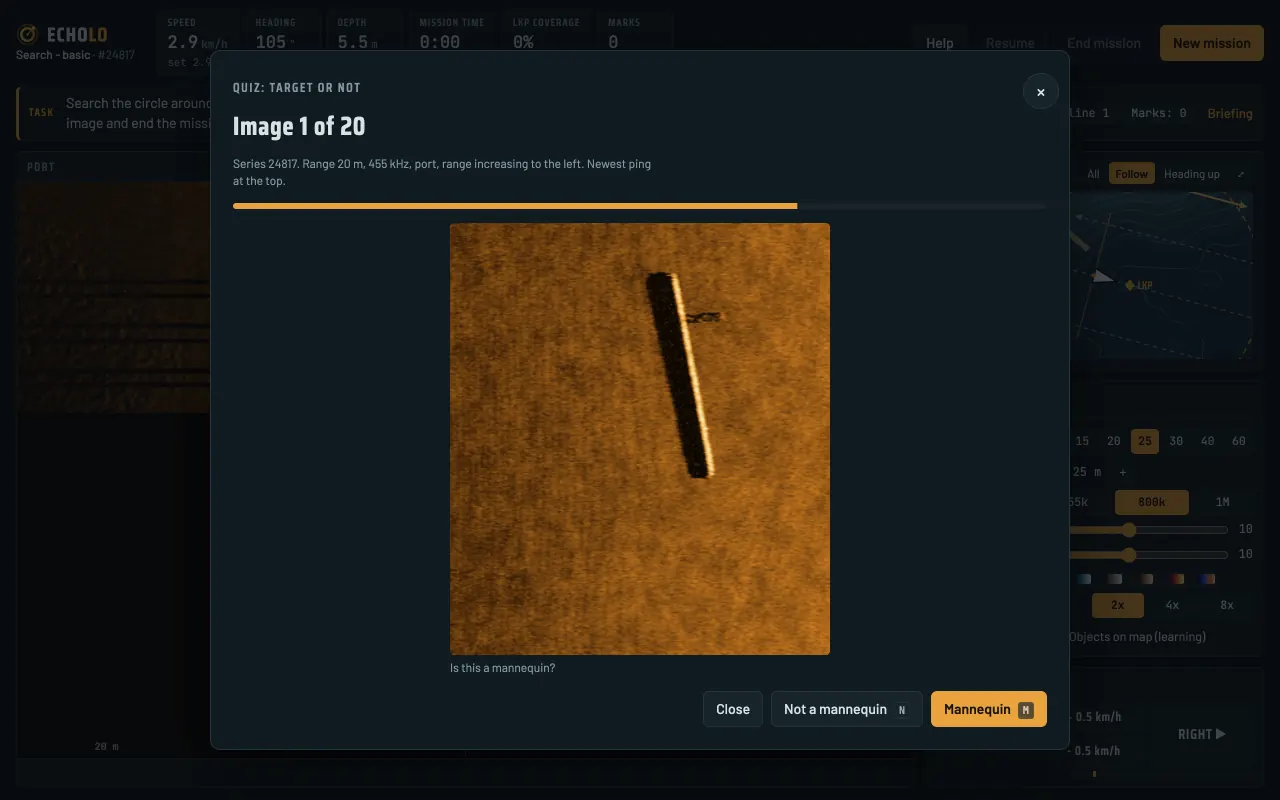
The bottom holds logs, tires, rocks, bicycles, shopping carts, branches, wrecks and cars, and the mannequin may be curled up, upright or partly buried in silt. The “target or not” quiz trains quick decisions, and viewing an object from eight directions shows why an echo is confirmed from another heading.
quiz: 20 images, 5 s per decision
Marking the target
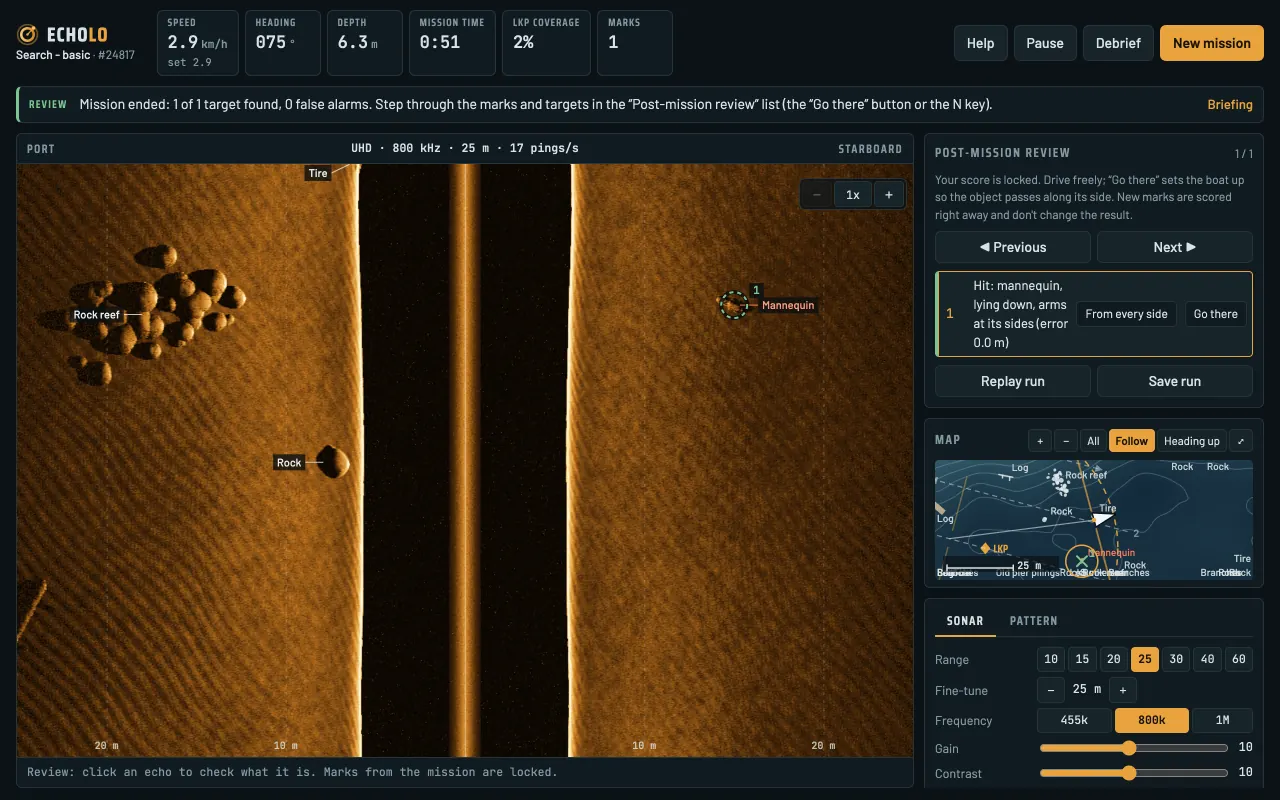
You place a mark on the image and the simulator turns it into a position on the bottom. After the mission each mark is judged: a hit within 5 m of the target, or a false alarm with an explanation of what it was (fish in the water column, debris, noise, another object).
hits · false alarms · mean position error
Learning
Practice area - target signatures
A flat, sandy bottom with ten labeled objects along the track line. Run the line with different range, frequency and speed and watch how the image changes.
Mission
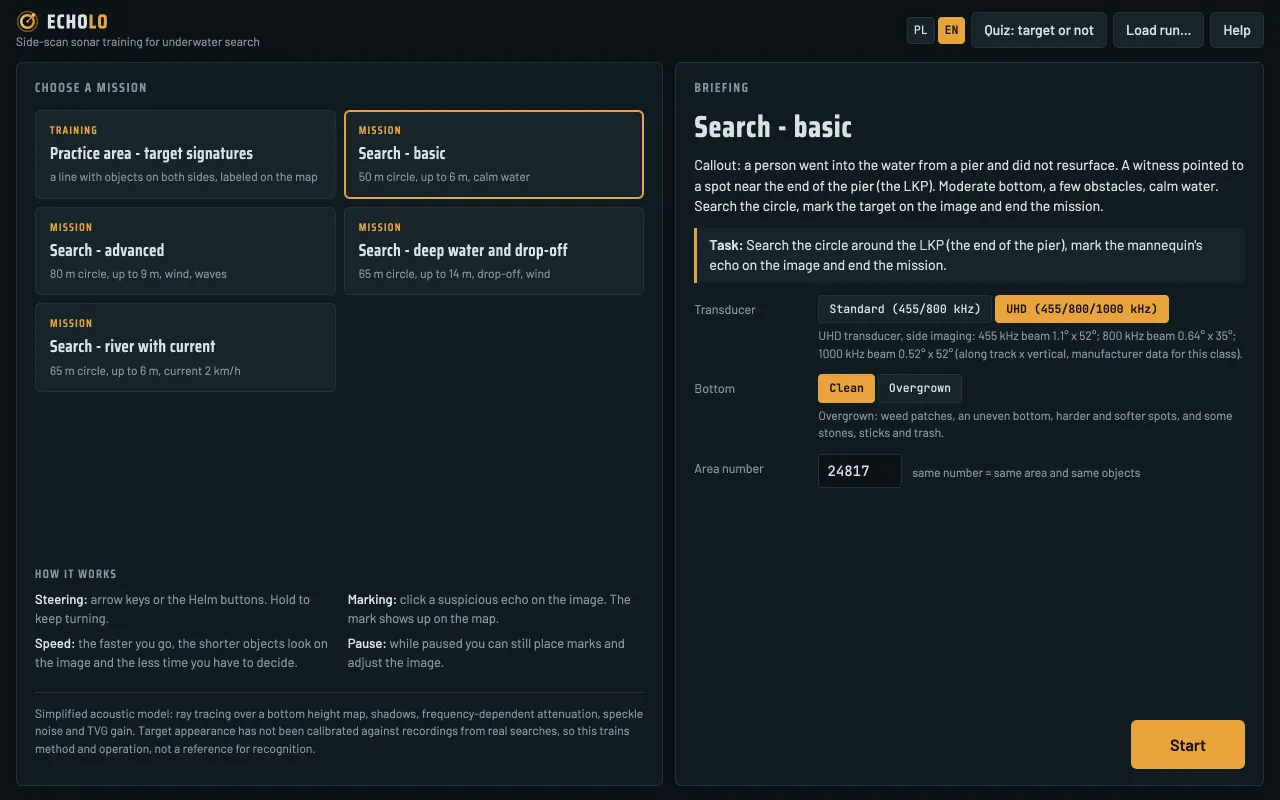
Search - basic
A person went into the water from a pier and didn't come up. A 50 m circle, up to 6 m deep, a few obstacles, calm water. This scenario is also the demo mission.
Mission
Search - advanced
An 80 m circle, up to 9 m deep, vegetation, lots of trash and schools of fish. Wind pushes the boat, waves rock the transducer, and the target may be partly buried in silt.
Mission
Search - deep water and drop-off
Past the shallows by the pier, the bottom falls away in a steep drop-off to 12-14 m. Match the range to the depth and check the foot of the drop-off from both sides.
Mission
Search - river with current
A current of about 2 km/h pushes the boat, so the search area lies downstream of where the person went missing. A bottom with dunes, and rock groynes with scour holes along the bank.
No boat
Quiz: target or not
Twenty images and 5 seconds per decision. A missed mannequin costs two points, a false alarm one, and after the series you see every mistake with a hint.
Every scenario can be played on a clean or overgrown bottom. The area number sets the bottom shape and the position of the mannequin and debris: an instructor can give a group one number and compare the runs afterwards.